
DRY EYE SPECIALTY CLINIC
Advanced Diagnostics.
Targeted Treatment. Lasting Relief.
Dry eye is not a single condition — it is a multifactorial disease with different underlying causes. Treating it properly requires identifying the root problem, not just masking symptoms.
At VODA Eyecare, our Dry Eye Specialty Clinic is designed to diagnose the true cause of your dryness using advanced imaging and testing, then build a customized treatment plan tailored specifically to your eyes.
STEP ONE
Root-Cause
Dry Eye Analysis
We use the Bruder Ocular Surface Analyzer to evaluate the tear film, oil glands, blink quality, and ocular surface health. This advanced diagnostic system allows us to assess:
Meibomian gland function
Tear stability
Lipid layer quality
Blink dynamics
Inflammation indicators
Instead of guessing, we identify exactly why your eyes feel dry — so treatment is precise and effective.
PERSONALIZED TREATMENT OPTIONS
Your Treatment,
Built Around Your Eyes
Your treatment is selected based on your specific dry eye type and severity. Many patients benefit most from combination therapy — addressing multiple contributing factors at the same time.
IPL THERAPY
01
Intense Pulsed Light
for Meibomian Gland Dysfunction
The most common driver of dry eye isn't insufficient tears — it's poor oil quality. When the meibomian glands become blocked or inflamed, the tear film evaporates too quickly. IPL targets that cycle at its source.
We offer medical-grade Intense Pulsed Light therapy by Lumenis for patients whose dryness is driven by oil gland dysfunction. IPL delivers precise light energy to the periorbital skin, targeting the abnormal blood vessels that sustain chronic lid inflammation. With each session, gland function improves, oil secretion normalizes, and tear film stability is restored — not masked.
Improves Gland Function
Restores healthy meibum flow and oil layer quality for a more stable, longer-lasting tear film.
Reduces Inflammation
Closes abnormal telangiectatic vessels that drive the chronic lid inflammation underlying most MGD.
Stabilizes Tear Film
Improved lipid secretion means tears evaporate more slowly — reducing dryness, burning, and fluctuating vision.
Enhances Comfort
Patients typically notice improved comfort and vision clarity with a series of 4 sessions over 6–8 weeks.
Who Benefits Most
Patients with confirmed Meibomian Gland Dysfunction
Those experiencing burning, grittiness, or fluctuating vision — especially in dry or screen-heavy environments
Anyone who has not found lasting relief with drops or warm compresses alone
Patients with rosacea — a common and often overlooked contributor to MGD
Best combined with triLift. IPL addresses the gland. triLift addresses the lid. For patients with both MGD and lid laxity, combining the two therapies produces the most complete and lasting improvement in ocular surface health.
triLift™
02
Non-Surgical Lid Laxity Treatment
for Blink Optimization
Most dry eye treatments focus on the tear film. But for many patients — especially those who haven't fully responded to IPL or other therapies — the real problem is in the lid.
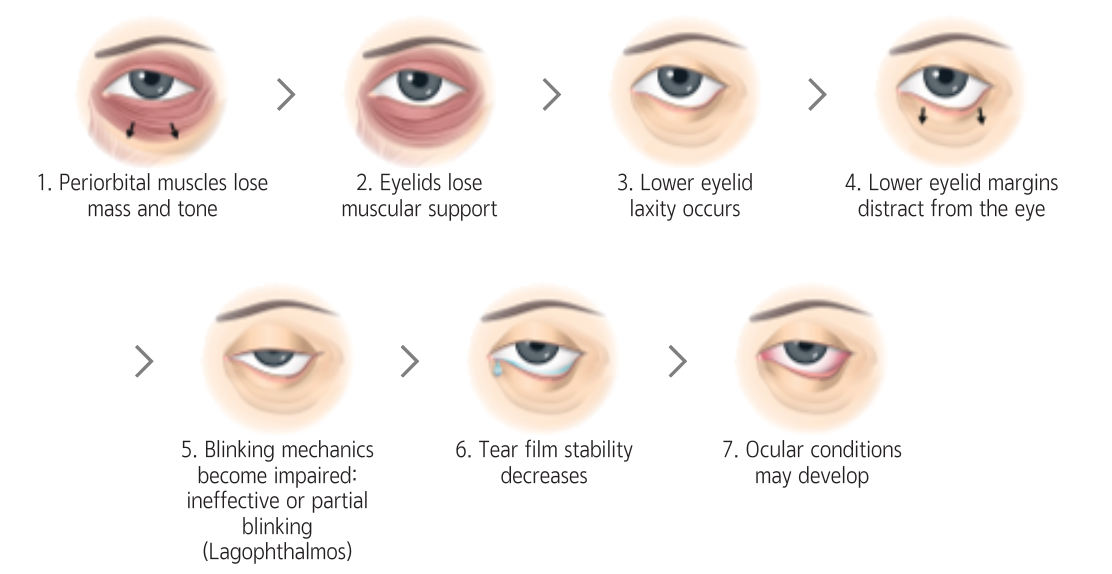
Lower lid laxity is one of the most underdiagnosed contributors to chronic dry eye. As the orbicularis oculi muscle weakens with age — losing mass at roughly 3–8% per decade after 30 — the lower lid gradually loses its structural support. The result: incomplete blinking, poor lid apposition, and inadequate meibomian gland compression. The evaporative dry eye cycle continues, no matter how well the gland itself is treated.
triLift addresses the root of that problem.
WHY LID FUNCTION MATTERS
DMSt Technology
Dynamic Muscle Stimulation activates and tones the periorbital muscles — restoring strength the same way targeted exercise works elsewhere in the body.
Radiofrequency Energy
RF energy tightens lid tissue and supports structural remodeling, improving lid apposition and long-term blink mechanics.
Strengthens Eyelid Muscles
Improved muscle tone means a more complete blink — better gland compression, more even tear distribution, and longer moisture retention.
~20 Min Per Eye
No needles. No surgery. No downtime. Return to normal activities immediately after each session.
CLINICAL EVIDENCE
Chelnis et al., 2025 — Clinical Ophthalmology | Prospective study, 4 weekly OptiLIFT sessions
77%
reduction in patients with lower lid laxity
100% → 23% of patients (p < 0.0001)
80%
reduction in patients with lower lid laxity
up from 3% at baseline
93%
achieved normal snapback test
up from 30% at baseline
70%
improvement in blink quality
+ blink rate normalized in 60% more patients
✦ Clinically significant improvement in dry eye signs and symptoms — zero adverse events
PATIENT RESULTS

After 4 sessions
Improved lid tone, more complete blink, reduced dryness symptoms.

After 4 sessions
Visible improvement in lid position and periorbital tone.
Individual results may vary. Photos are of actual patients treated at VODA Eyecare.
Who Benefits Most
Patients with persistent dry eye symptoms despite prior treatment
Anyone noticing heaviness around the lids, incomplete blinking, or eyelid changes with age
Adults in their 30s and beyond — especially those with heavy screen use
Patients whose symptoms worsen toward the end of the day or during prolonged focus tasks
Anyone who wants their eyes to feel and look more open, rested, and alive — without surgery
Better together. triLift pairs naturally with our OptiLight IPL therapy — treating both the meibomian gland and the lid structure at the same time. For many patients, this combination delivers the most complete and lasting relief.
PUNCTAL PLUGS
03
Tear Retention Therapy
for Aqueous Deficiency
When the body simply isn't producing enough tears, the priority shifts from improving quality to preserving what's there. Punctal plugs keep your natural tears on the eye's surface — longer.
For patients whose dryness is caused by insufficient tear production, punctal plugs help retain natural tears on the eye surface — providing longer-lasting hydration and symptom relief. Tiny biocompatible devices are placed in the punctal openings at the inner corner of each eyelid to slow tear drainage, extending the time your natural tears remain in contact with the ocular surface.
Temporary Plugs
Dissolvable collagen or hydrogel plugs last days to weeks — ideal for trialing the treatment or post-procedure recovery.
Semi-Permanent Plugs
Silicone plugs provide lasting tear retention and can be removed at any time. Most patients don't feel them once placed.
Minutes In-Office
Placement takes just a few minutes per eye with topical anesthetic. No downtime, no incisions. Many patients notice relief immediately.
Preserves Natural Tears
Retaining your own tears means healthier corneal coverage and less reliance on artificial lubricant drops throughout the day.
Who Benefits Most
Patients diagnosed with aqueous deficiency dry eye or Sjögren's syndrome
Those using artificial drops multiple times daily with limited lasting relief
Patients whose dryness is associated with hormonal changes, aging, or systemic medications
Anyone recovering from LASIK, cataract surgery, or other ocular procedures
Often used alongside IPL or triLift. Many patients have a mixed dry eye profile — gland dysfunction and reduced tear volume. In those cases, punctal plugs complement IPL or triLift by addressing the aqueous layer while the other therapies target the lipid layer and lid mechanics.
Safe, Comfortable,
No Downtime.
THE VODA APPROACH
Dry Eye Rarely Has
Just One Cause.
For many patients, the most effective results come from combining treatments — addressing multiple contributing factors at once. We design each plan based on your diagnostic results, symptoms, and lifestyle. Our focus is long-term improvement, not temporary relief.
IPL + triLift
Treats meibomian gland dysfunction and lid laxity simultaneously — addressing both oil quality and the mechanical blink that delivers it.
IPL + Punctal Plugs
For mixed dry eye — concurrent MGD and aqueous deficiency. Improves both tear quality and tear retention at the same time.
Device + Medical Drops
In-office therapies combined with targeted prescription drops for patients who benefit from both structural treatment and ongoing medical management.
All Three Therapies
For complex or refractory cases — a comprehensive plan targeting the gland, the lid, and tear volume, built around your diagnostic results.
By targeting the underlying cause, we aim to restore natural tear balance and improve ocular comfort, clarity, and overall eye health — for the long term.
SCHEDULE A DRY EYE EVALUATION
Relief Starts With
Understanding the Cause.
Let us identify what's really happening and build a treatment plan designed just for you.